Voice Activity Detection (VAD)
Energy-based
A simple energy-based VAD is implemented in bob.kaldi.compute_vad().
The function expects the speech samples as numpy.ndarray and the sampling
rate as float, and returns an array of VAD labels numpy.ndarray
with the labels of 0 (zero) or 1 (one) per speech frame:
>>> sample = pkg_resources.resource_filename('bob.kaldi', 'test/data/sample16k.wav')
>>> data = bob.io.audio.reader(sample)
>>> VAD_labels = bob.kaldi.compute_vad(data.load()[0], data.rate)
>>> print (len(VAD_labels))
317
DNN-based
A Deep Neural Network (DNN), frame-based, VAD is implemented in
bob.kaldi.compute_dnn_vad(). Pre-trained DNN on AMI database
with headset microphone recordings is used for forward pass of mfcc
features. The VAD decision is computed by comparing the silence
posterior feature with the silence threshold.
>>> DNN_VAD_labels = bob.kaldi.compute_dnn_vad(data.load()[0], data.rate)
>>> print (len(DNN_VAD_labels))
317
Speaker recognition evaluation
MFCC Extraction
Two functions are implemented to extract MFCC features
bob.kaldi.mfcc() and bob.kaldi.mfcc_from_path(). The former
function accepts the speech samples as numpy.ndarray, whereas the latter
the filename as str:
-
>>> feat = bob.kaldi.mfcc(data.load()[0], data.rate, normalization=False)
>>> print (feat.shape)
(317, 39)
-
>>> feat = bob.kaldi.mfcc_from_path(sample)
>>> print (feat.shape)
(317, 39)
UBM training and evaluation
Both diagonal and full covariance Universal Background Models (UBMs) are supported, speakers can be enrolled and scored:
>>> # Train small diagonall GMM
>>> diag_gmm_file = tempfile.NamedTemporaryFile()
>>> full_gmm_file = tempfile.NamedTemporaryFile()
>>> dubm = bob.kaldi.ubm_train(feat, diag_gmm_file.name, num_gauss=2, num_gselect=2, num_iters=2)
>>> # Train small full GMM
>>> ubm = bob.kaldi.ubm_full_train(feat, dubm, full_gmm_file.name, num_gselect=2, num_iters=2)
>>> # Enrollement - MAP adaptation of the UBM-GMM
>>> spk_model = bob.kaldi.ubm_enroll(feat, dubm)
>>> # GMM scoring
>>> score = bob.kaldi.gmm_score(feat, spk_model, dubm)
>>> print ('%.3f' % score)
0.282
iVector + PLDA training and evaluation
The implementation is based on Kaldi recipe SRE10. It includes ivector extrator training from full-diagonal GMMs, PLDA model training, and PLDA scoring.
>>> plda_file = tempfile.NamedTemporaryFile()
>>> mean_file = tempfile.NamedTemporaryFile()
>>> spk_file = tempfile.NamedTemporaryFile()
>>> test_file = pkg_resources.resource_filename('bob.kaldi', 'test/data/test-mobio.ivector')
>>> features = pkg_resources.resource_filename('bob.kaldi', 'test/data/feats-mobio.npy')
>>> train_feats = numpy.load(features)
>>> test_feats = numpy.loadtxt(test_file)
>>> # Train PLDA model; plda[0] - PLDA model, plda[1] - global mean
>>> plda = bob.kaldi.plda_train(train_feats, plda_file.name, mean_file.name)
>>> # Speaker enrollment (calculate average iVectors for the first speaker)
>>> enrolled = bob.kaldi.plda_enroll(train_feats[0], plda[1])
>>> # Calculate PLDA score
>>> score = bob.kaldi.plda_score(test_feats, enrolled, plda[0], plda[1])
>>> print ('%.4f' % score)
-23.9922
Deep Neural Networks
Forward pass
A forward-pass with pre-trained DNN is implemented in
bob.kaldi.nnet_forward(). Output posterior features are
returned as numpy.ndarray. First output features of each row (a
processed speech frame) contain posteriors of silence, laughter
and noise, indexed 0, 1 and 2, respectively. These posteriors are thus
used for silence detection in bob.kaldi.compute_dnn_vad(),
but might be used also for the laughter and noise detection as well.
>>> nnetfile   = pkg_resources.resource_filename('bob.kaldi', 'test/dnn/ami.nnet.txt')
>>> transfile = pkg_resources.resource_filename('bob.kaldi', 'test/dnn/ami.feature_transform.txt')
>>> feats = bob.kaldi.cepstral(data.load()[0], 'mfcc', data.rate, normalization=False)
>>> nnetf = open(nnetfile)
>>> trnf = open(transfile)
>>> dnn = nnetf.read()
>>> trn = trnf.read()
>>> nnetf.close()
>>> trnf.close()
>>> ours = bob.kaldi.nnet_forward(feats, dnn, trn)
>>> print (ours.shape)
(317, 43)
Speech recognition
Speech recognition is a processes that generates a text transcript given speech audio. Most of current Automatic Speech Recognition (ASR) systems use the following pipeline:
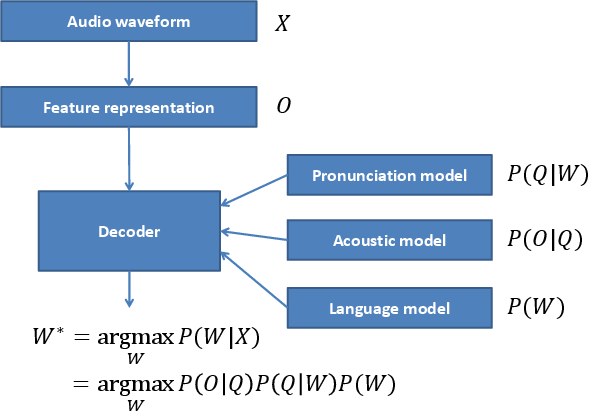
The ASR system has to be first trained. More specifically, its key statistical models:
- Pronunciation model, the lexicon, that associates written and spoken
form of words. The lexicon contains words
 and defines them
as sequences of phonemes (the speech sounds)
and defines them
as sequences of phonemes (the speech sounds)  .
. - Acoustic model, GMMs or DNNs, that associates the speech features
 and the spoken words .
 - Language model, usually n-gram model, that captures most probably
sequences of of a particular language.
The transcript of the input audio waveform  is then generated
by transformation of to features (for example
ceptral features computed by
is then generated
by transformation of to features (for example
ceptral features computed by bob.kaldi.cepstral()), and an
ASR decoder that outputs the most probable transcript  using the pre-trained statistical models.
Acoustic models
The basic acoustic model is called monophone model, where
consists just of the phonemes, and consider them contextually
independent. The training of such model has following pipeline:
- Model initialization for a given Hidden Markov Model (HMM) structure, usually 3-state left-to-right model.
- Compiling training graphs that compiles Finite State Transducers (FSTs), one for each train utterance. This requires the lexicon, and the word transcription of the training data.
- First alignment and update stage that produces a transition-model and GMM objects for equally spaced alignments.
- Iterative alignment and update stage.
>>> fstfile   = pkg_resources.resource_filename('bob.kaldi', 'test/hmm/L.fst')
>>> topofile = pkg_resources.resource_filename('bob.kaldi', 'test/hmm/topo.txt')
>>> phfile = pkg_resources.resource_filename('bob.kaldi', 'test/hmm/sets.txt')
>>> # word labels
>>> uttid='test'
>>> labels = uttid + ' 27312 27312 27312'
>>> train_set={}
>>> train_set[uttid]=feats
>>> topof = open(topofile)
>>> topo = topof.read()
>>> topof.close()
>>> model = bob.kaldi.train_mono(train_set, labels, fstfile, topo, phfile , numgauss=2, num_iters=2)
>>> print (model.find('TransitionModel'))
1