Idiap researchers and their colleagues worldwide are investigating the generalization and personalization of models using mobile sensor data to infer people’s mood. A Distinguished Paper Award at the Ubicomp/ISWC conference recognized the scientific publication presenting this research.
In a systematic review, Idiap researchers analyzed urban data crowdsourcing platforms around the world. Their work highlights the growing role of these platforms to inform urban policies and shed light on the state of development of these tools.
In June, Dr. Matteo Sorci joined Idiap as Innovation Manager, bringing to the Institute his 14-year innovation expertise gained in the world of high-tech development and commercialization.
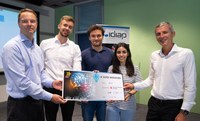
After nine days of intense work, Idiap Research Institute has announced the winners of the 12th edition of the Idiap Create Challenge (ICC) 2023. This artificial intelligence hackathon brought together engineers and creatives from several countries to transform their ideas into working prototypes with the help of the institute.
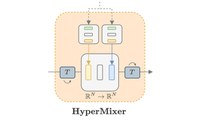
As artificial intelligence technologies reach everyday new performances, their energy cost is also increasing significantly. Idiap researchers are proposing a novel approach to address this challenge during a period of rising energy costs.
On 1 May 2023 the Board of Directors of the Swiss Academies of Arts and Sciences elected five new members to the Swiss Young Academy (SYA). With this election, the Academies acknowledge the ideas and commitment of the newly-elected members at the interfaces between science, society and politics.
Attracted to Idiap thanks to the Idiap Female Fellowship Researchers program, Raphaëlle Luisier has been promoted to permanent researcher at the Institute.
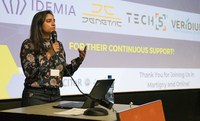
Idiap hosted a Biometrics Week. This one of a kind event gathered several hundreds of people from various backgrounds ranging from academia to industry. Organizers included the European Association for Biometrics and the US based Center for Identification Technology Research.
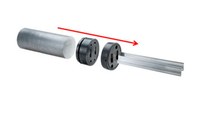
An Innosuisse project allowed Idiap to set up AI tools able to help experts to study the manufacturability of new aluminum elements requested by their customers.
The Idiap Research Institute uses signal processing and machine learning to design effective tools to improve people’s daily lives, especially those with communication difficulties. Ina Kodrasi, head of the Signal Processing for Communication group, is contributing to significant advances in the field of pathological speech.
Created in 2022, Cross Research Groups will foster collaborations between Idiap research groups. Their aim is to have long-term impacts on society thanks to an approach mixing both business oriented solutions and interdisciplinary scientific groundwork.
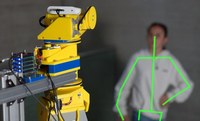
Luminous paints make it possible to tell the time on analogue timepieces even in the dark. These compounds are still applied manually, as conventional automation solutions are not suitable for this task. That’s why researchers from Idiap and Bern University of Applied Sciences BFH are developing a flexible robot system that can be programmed by showing it what to do.
Head of the Social Computing research group, Daniel Gatica-Perez has contributed to Idiap’s vision of Artificial Intelligence for Society since 2002. Last year, he received two awards recognizing his long-term impact at the interface between technology and society.
Every year, the Institute nominates two students for its internal awards. In 2022, the Paper Award goes to Alexandre Bittar, and the Student Award goes to Teguh Lembono. Congratulations!
In anticipation of the retirement of its current director, Hervé Bourlard, the Idiap Foundation Council is pleased to announce that Andrea Cavallaro will soon be taking over as director of the institute. He is also appointed full professor at EPFL’s School of Engineering.
Esau Villatoro, research associate at the Speech & Audio Processing group at Idiap, and his colleagues from the Mathematics Research Center (CIMAT) from Mexico have won first place in two competitions related to Natural Language Processing. The objective of these competitions is to improve important aspects of Mexican society such as tourism and communication.
Former Idiap PhD Angelos Katharopoulos has received EPFL's Electrical Engineering Doctoral program (EEDE) Thesis Award for his outstanding research on the efficiency of deep learning models.
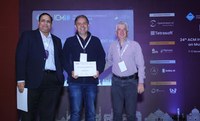
The award was presented at the ACM International Conference on Multimodal Interaction in Bengaluru, India, on November 9, 2022.
Idiap researchers published a paper describing an approach to speech processing based on the properties of the human brain. Their method proved as efficient as the current standard, whilst conserving the advantage of energy efficiency. Moreover, their work is replicable thanks to open access software paving the way for future applications.
 A study about the generalization of mood inference models distinguished by an award